8 Fascinating Castle Ruins to Visit in the South of France
It is estimated that there are more than 45,000 châteaux (castles) in France. Some, like Château de Versailles. Château de Chenonceau, and Château de Chambord have been beautifully restored; however, there are many that are still in ruins and for me, are just as beautiful. Whether it is getting panoramic views from up high or walking through the remaining structure of a castle, there is something special about visiting the ruins. In this post I’m highlighting 8 châteaux in the south of France (Occitanie and Provence-Alpes-Côte d’Azur regions) that I have visited and highly recommend you visit.
Table of contents
8 Fascinating Castle Ruins In The South Of France
Before diving into the list, here’s how I define what qualifies as a ‘ruin’ for this post.
Each castle has its own story, and as you explore, you’ll get a glimpse of both its past grandeur and the marks time has left behind. Châteaux in France were once grand residences—some fortified for defence, others purely built for status and comfort. Today, many lie partially or completely in ruins due to war (like the French Revolution or World War II), historical events, neglect, or simple decay over time. When you visit, you might find crumbling towers, missing roofs, or entire sections open to the sky. And yet, what remains still gives insight into the château’s former glory. A few have been lightly restored to help visitors imagine what they once looked like.
In each description, I’ll share a bit of history, what led to its current state, and why I think it’s worth the visit. Here are the 8 I’m spotlighting:
- Château de Queribus
- Château de Peyrepertuse
- Château de Najac
- Château de Calmont d’Olt
- Château de Lagarde
- Château des Baux-de-Provence
- Château de Brousse
- Château d’If
Click on the map or on this link and you’ll be directed to a Google Map indicating all the places in this post.

1. Château de Queribus: A Cathar Stronghold in Ruins
Location: Cucugnan (Department: Aude)

A Short History
In the Aude department of Occitanie, Château de Queribus is one of the “Five Sons of Carcassonne” —-one of 5 castles (along with Peyrepertuse, Puylaurens, Aguilar and Termes) that were situated high in the French Pyrenees mountains.
Château de Queribus rises 728 metres and overlooks the Corbières hills and the Roussillon plain. It was perfectly situated as a Cathar resistance and defence against the Spanish (Kingdom of Aragon) in the 10th century. Then, when the Catholic crusaders and the papal Inquisition came, it became a refuge for the Cathars. It is considered the last stronghold of the Cathars.
Who Were The Cathars?
The Cathars were a religious movement in the 12th-14th centuries, primarily in southern France. They believed in two gods-one good and one evil (dualism) and they rejected everything about the Catholic church. As a result, the Catholic church sought to crush them. The châteaux were often royal or noble fortresses and owned by lords who supported the Cathars. During the inquisition, the Cathars were eliminated.
From Fortress to Ruin
Château de Queribus was taken over by the French crusaders in 1255 and its importance diminished when the French decided to move the borders further south in 1659. In the 1950s, restoration to the turret was done and between 1998 and 2002 a complete restoration was performed, but to be honest, it sure doesn’t look restored!
Why Visit?

It took me about an hour to get to Château de Queribus from Prades where I was based during my Trip #33: 2 Months In France . Not only was the drive to the château windy, but up top, it was incredibly gusty! You’ll no doubt be impressed by the enormity of the castle as you drive towards it. High above, perched on a mountain top sits the château.
The walk up to the chateau was easy and not too steep. It took about 15 minutes. Once up top, I had to take my hat off or it would have blown away. Just keep that in mind.
While this château has been destroyed, enough has been restored that it is safe to visit and is worth visiting for the panoramic views. It’s a small château and I only stayed an hour.
2. Château de Peyrepertuse
Location: Duilhac-sous-Peyrepertuse(Department: Aude)

A Short History
One of the “Five Sons of Carcassonne”, Château de Peyrepertuse is less than 15 minutes away from Château de Queribus and is another of the Cathar strongholds. It is the largest, so if you’re going to visit one, you might as well visit both.
Peyrepertuse comes from “pèira pertusa” in the Occitan language and it means “pieced stone”. The chateau originated in the 11th century and belonged to the Count of Besalu and spread over 300 metres over the rocky ridge at an altitude of 800 metres. It is said that it looked like a gigantic ship.
This château sits on a rocky spur of a mountain, overlooking the valley with a clear view in every direction. It has many interesting remains of the interiors and tower and enclosed by a wall that you can walk around.
Why Was It Abandoned?
The castle was repeatedly seized, rebuilt, and repurposed. In 1240, Louis IX took over Château de Peyrepertuse and it became a royal fortress in the 13th century. One of the orders he gave to the Seneschal [governor or administrator] of Carcassonne was that a staircase leading to the highest point (the San Jordi Keep) be constructed.
Château de Peyrepertuse and Queribus were the only two chateaux that could be viewed from one another, making communication between them possible. This proved to be useful to provide advance warning about attackers.
But like Queribus, Château de Peyrepertuse’s importance decreased when the border was moved further south. As a result, the castle lost its strategic importance and was abandoned during the French Revolution.and fell into disrepair and ruin. In 1820 it was sold as a national property and in 1908 became a Historic Monument.
Why Visit?

Like the other Cathar castle, the drive toward Château de Peyrepertuse is impressive. It sits high on a cliff of a rocky limestone ridge. I stopped in Cucugnan first to have lunch. I couldn’t drive into town as cars weren’t allowed and there was no parking. I had the plat du jour for 10 € and after lunch walked to the chateau. It took about 30 minutes.
It is a much more difficult hike than the one to Château de Queribus and the site is pretty “rugged” so not especially safe for young children. Remember to wear good walking shoes….even hiking boots because you’ll be walking (and climbing) through a wooded area on a steep path that has stones and rocks. Also remember to bring water.
The Saint-Louis staircase was carved into the rock and was recently restored. Once at the top of the ruins, you’ll get excellent 360° panoramic views of the landscape.

In my journal, I actually wrote that Château de Peyrepertuse was “unreal…perhaps better than Château des Baux-de-Provence?” I was duly impressed and stayed about 2 hours. As you can see from the photos, the climb up is not particularly easy, but the views are dramatic and worth the effort. And during high season, there are often special events and medieval festivals. There is an audio guide and an English pamphlet.
3. Forteresse Royale de Najac

Location: Najac (Department: Aveyron)
A Short History
I visited Najac en route between Albi and Libourne (NE of Bordeaux) and was glad I did. But, it’s the château at Najac, also known as Forteresse Royale de Najac, really, not the village of Najac that is the attraction. The 13th century Château de Najac is built into the rock and teeters above the village. From the highest point, you can get really impressive panoramic views of the Aveyron Gorges and valley. Some of the château has been preserved and restored, but much is still in ruins.
Built in two phases, the first was in the 1200s, by the counts of Toulouse as a defence. Then in the 13th century, the brother of King Louis, Alphonse de Poitiers suite the 130 foot high keep. It is said that due to the high position, 2 enclosures, a drawbridge, and defensive features, no one ever attempted to overtake the château during those early centuries.
The Castle’s Downfall
In addition to enduring occupations during the Hundred Years’ War and Wars of Religion and even by the peasants in the 1600s (Revolt of the Croquants), it was really after the 1640s that the castle fell into ruins and was abandoned. It wasn’t until the 19th century that the wealthy Cibiel family bought the chateau and began restoring it.
Why Visit?

I think what makes Forteresse Royale de Najac so interesting is it’s position on a rocky spur. Whether from the road below or up top, the views are worth the visit. The sections that have been restored (ie. the chapel, keep (donjon), and secret passageway) are well done.
4. Château de Calmont d’Olt

Location: Espalion(Department: Aveyron)
A Short History
For almost a week in Aveyron department, I stayed in nearby Espalion (Trip #39) and everyday when I looked up I could see the partially ruined medieval fortress, Château de Calmont d’Olt high on a nearby hill. So of course I had to visit it.
Construction on the château began in the 11th century. It was to be a residence for the Lords of Calmont. An additional curtain wall enclosure and 8 towers were added in the 15th century during the Hundred Years’ War.
From Abandonment to Restoration
The castle fell into ruins beginning in the 17th century when the owners abandoned it. In 1987, Thierry Plume purchased the castle and began the restoration process and in 1992 it was classified as a historic monument.
Why Visit?
I could have driven up to the castle which is located 535 metres above Espalion; however, I decided to walk there. It was an easy enough uphill journey and only took me 45 minutes. To my surprise, up top was absolutely freezing. Although it was mid October and 18° C, the wind was very strong. Something to keep in mind when you visit.
Admission was 6 € (low season) and there were many displays of medieval weapons in the courtyard and even a demonstration of the trebuchet, which is kind of like a giant slingshot/catapult. Depending on the timing of your visit, you can also see archery and other medieval weaponry demonstrations. Workers show their masonry and stone cutting skills as well. Tours are also available; however, I am not sure if they are just in French.
You get excellent 360° panoramic views of the land below (Espalion and the Lot valley), and there is enough left of the ruins of this 11th century castle which has not been restored. But you can get an idea of how big this château used to be. There is really only one “interior” room to visit. It has various artifacts and uniforms. What remains of the château is primarily exterior walls-well actually fragments of walls, as most of them have partially collapsed, deteriorated, or crumbled.
5. Château de Lagarde

Location: Lagarde(Department: Ariège)
A Short History
I really enjoyed visiting Château de Lagarde because it was so interesting. The original fortress was built in the 11th century. From the 13th to 17th century, much work was put into constructing the “Versailles des Pyrénées”, complete with French gardens, terraces, and ponds, just like Versailles near Paris.
Why It Fell Into Disrepair
Through the centuries and in particular during the French Revolution, the château was looted, destroyed, and fell into disrepair. It was even used as a stone quarry and while the volunteer organization tried to raise funds to make repairs, it just wasn’t enough. It was neglected and left to fall apart.
Why Visit?
In 2024 it was announced that the château was for sale and available for free, but with a catch. The buyer would still need to do restorations that could cost several millions of Euros. Still interested? Check out what remains of this very impressive castle in the Ariège department: Impressive Castle Ruins: Château de Lagarde In The Ariège.
You’ll only be able to visit the site when there are special events. Visitors are no longer permitted to visit the château on self-guided tours. There was an event July 6, 2025 where the theme was vintage cars and motorcycles. I can imagine it was a picture-perfect day, with the ruins of Château de Lagarde providing a beautiful setting for those classic vehicles.
6. Château des Baux-de-Provence
Location: Les Baux-de-Provence (Department: Bouches-du-Rhône)
A Short History
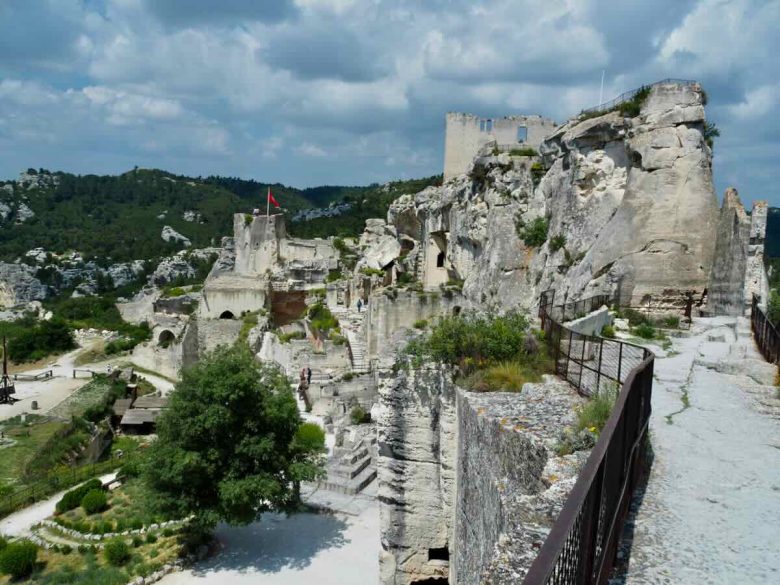
As I wrote in this post, “Why You Should Visit Le Château des Baux-de-Provence”, the powerful Baux family built the château on top of a plateau—a fortress in fact—beginning in the 10th century with a fortified town and then in the 13th century with a castle. It is located not far from Saint-Rémy-de-Provence in the Alpilles mountains, overlooking the town of Les Baux-de-Provence.
The Castle’s Destruction
Château des Baux-de-Provence was involved in many battles resulting in the destruction (and reconstruction) through the centuries. In 1426, the last Princess of Baux died without an heir and the castle was passed to the count’s estates and then to the Crown.
Unfortunately, more unrest continued with a siege by Cardinal Richelieu under orders from King Louis XIII in 1632. From then on, the château fell into disrepair.
Why Visit?
The town, Les Baux, became a tourist attraction in the 20th century thanks to the art shops and exhibitions and numerous restaurants, such as the Michelin-starred restaurant L’Oustau de Baumanière. [Often highlighted in the 1980s television show, “Lifestyles Of The Rich And Famous”].
In the summer, the château has many medieval siege weapons on display and demonstrations. And nearby you can visit the famous Les Carrières des Lumières, where immersive art exhibitions are projected on the limestone quarry walls.
7. Château de Brousse

Location: Brousse-le-Château (Department: Aveyron)
A Short History
Towering over the village, Brousse-le-Château, Château de Brousse in the Aveyron department is another fortress that was constructed in the 9th century by the Counts of Rouergue to defend their territory. Between the 13th and 17th centuries it belonged to the Counts of Rodez and then the Arpajon family. In 1839 it was bought by the commune.
It is located at the confluence of the Tarn and Alrance rivers and like the châteaux of Peyrepertuse and Najac, this château also sits on a rocky spur overlooking the Tarn valley. Some say it looks like the bow of a ship with ramparts, fortified walls and 5 towers. It was in the ideal strategic position.
From Fortress to Village Landmark
In the late 1800s, the village was at risk of disappearing; however in the 1960s, the the association de la Vallée de l’Amitié began the restoration of the château and buildings in the village and the efforts transformed the village into a tourist attraction and as I wrote in my list of designated “Les Plus Beaux Villages de France”, the medieval village, Brousse-le-Château became a member of this esteemed group of beautiful villages in 2015.
Why Visit?
I drove from Saint-Affrique, east of the village and as I approached Brousse-le-Château, I was presented with a beautiful panoramic views. The château is the centrepiece of the village and before touring the château and its ruins, I had a lovely lunch with the château right in front of me.
It is an uphill walk along cobblestone paths to get to the château but once there, you’ll get excellent views of the surrounding area. The castle has been restored and there are displays of medieval armour and weaponry.
8. Château d’If

Location: Off the coast of Marseille (Department: Bouches-du-Rhône)
A Short History
In the early 1500s, King Francis I had the royal fortress, Château d’If, constructed to protect the French coast from invasions. While the fortress was never used to defend France it was soon turned into a prison from from 1541-1945 for political and religious opponents and during World War II for German prisoners.
Château d’If is probably best known as the setting for Alexandre Dumas’ novels, ‘The Count of Monte Cristo” and “The Man In The Iron Mask”.
From Prison To Legend
Château d’If wasn’t destroyed but rather, stopped being used as a fortress. It then became a prison and when it not longer served that purpose, it was left as is….with graffiti on the walls and prison doors still in tact. The Parc National des Calanques continues to maintain it as a tourist attraction.
Why Visit?
As I wrote in this post, ”Excursion To France’s Alcatraz: Chateau d’If”, a great outing in the south of France is to take a boat ride from Marseille over to Château d’If. The views of Marseille and your approach to the small island of Île d’If are wonderful. Once you arrive on the island you’re transported to another time as you explore the prison and see the awful conditions prisoners had to endure.
You’ll discover that if you were a ‘wealthy” prisoner, you got a few more amenities like a window! There are dungeons, towers and courtyards to visit as well as cells named after real (and fictional) prisoners like Edmond Dantès, the Count of Monte Cristo.
A Word About Château de Montségur
I would have included Château de Montségur in my list; however, I never made it there. I arrived in the parking lot and the fog was so thick it was too dangerous to visit. I would likely have killed myself trying to walk up the hill to the château. And there would be absolutely NO views. Perhaps it was closed anyways. I’ll have to go back one day to see this magnificent 13th century fortress that is perched 1,200 metres high in the French Pyrénées.
Château de Montségur is located 120 kilometres south of Toulouse. It is renowned as the last stronghold of the Cathars. Tragically, after a 9 month siege against the fortress in 1244, almost 200 Cathars were burned to death when they refused to renounce their faith. The original Cathar fortress was torn down by royal forces and today, there remains are from a rebuilt fortress.
Pin to your favourite board on Pinterest